


Good question!
tldr:
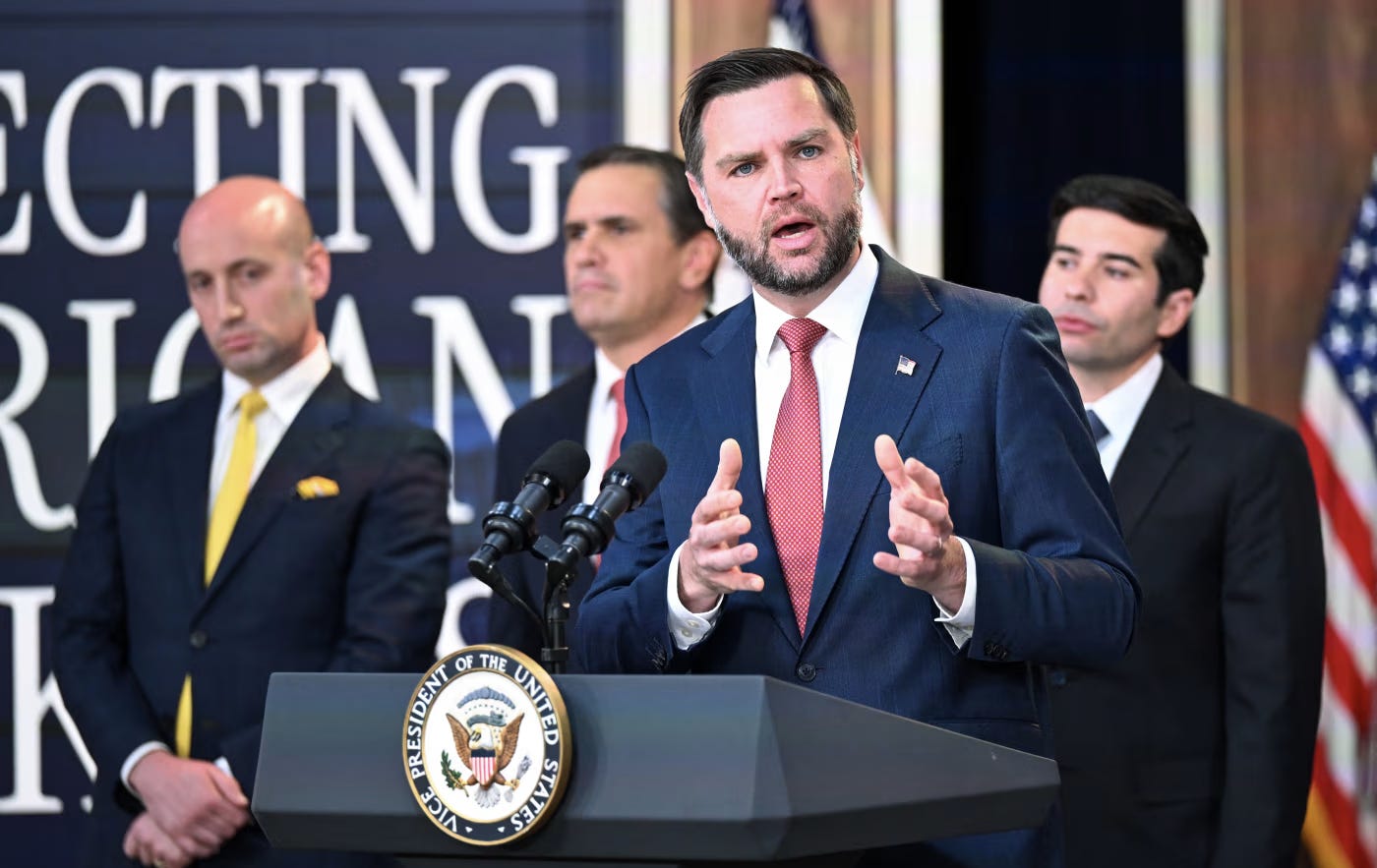
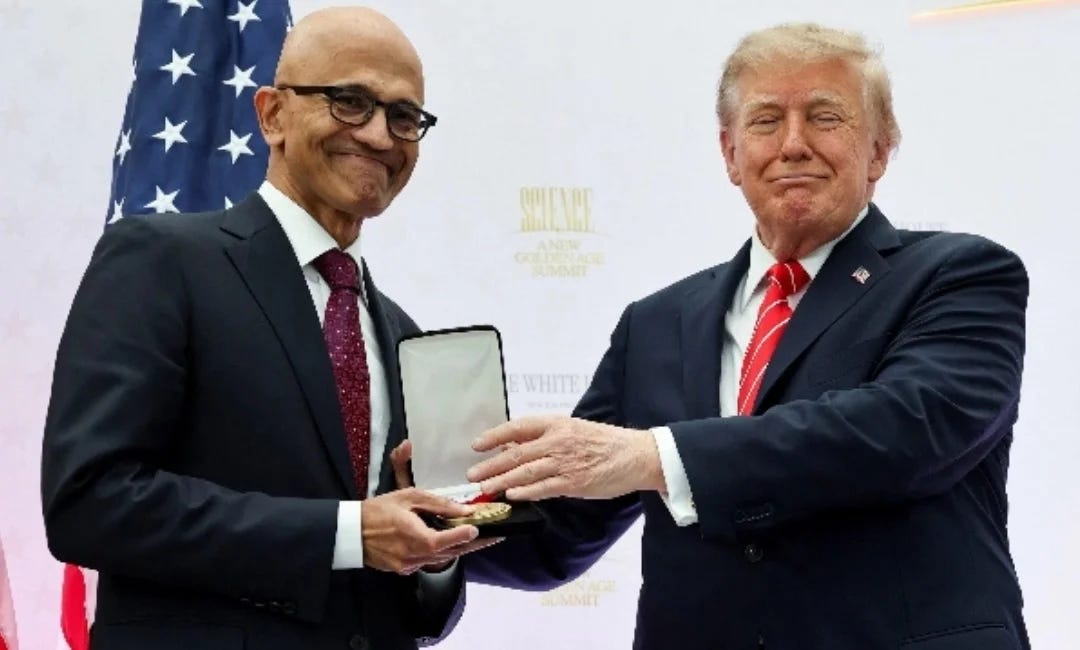
Good job helming a trillion-dollar company, Satya. Now let’s make sure it doesn’t happen again. Sources: WSJ and IndiaWest.
Background
On Thursday, JD Vance announced two new initiatives aiming to - depending on your point of view - either crack down on visa abuse or frighten prospective immigrants and their employers. Perhaps both!
Firstly, the White House is blocking Microsoft and seven other companies from applying for green cards for their employees.1 Specifically, these employers have had their participation in the Department of Labor’s Permanent Labor Certification program suspended.
British people love to say that Americans don’t understand irony, but President Trump clearly does. On Thursday, while the vice president scolded Microsoft to “hire great American workers”, the president himself awarded Microsoft’s CEO Satya Nadella the National Medal of Technology and Innovation. Nadella is an Indian immigrant, now an American citizen, who obtained his green card while working at Microsoft.2
Secondly, the Department of Labor is investigating nine universities3 for their handling of the J-1 Exchange Visitor visa, often used by postdoctoral researchers and visiting scholars. These universities are accused of hiring immigrants to undercut the wages of their native-born workers. Subpoenas have been served and universities around the country are on high alert.
We’ll dive into the claims that the administration has made about each of these programs, and see how they hold up.
Microsoft and co. get their PERM suspended
A Primer on PERM
But first: What is PERM? We’ll spare you the details;4 here are the basics:
PERM is the most common pathway to an employment-based green card.
To get the certification under PERM, an employer must show that they cannot hire a qualified American to perform a certain job. This justifies moving an immigrant from a short-term visa to long-term permanent residency.
This is often used to transition workers on an H-1B visa, America’s most popular skills-based visa and a repeated target of the administration, to permanent residency.
Note that in the US, there is no automatic transition to permanent residency after a period of residence; for a person on an H-1B to obtain a green card, they need to either be sponsored by their employer for a green card or marry an American citizen.5 This suspension cuts off employees at these companies from getting green cards.
Why do this? The White House’s rationale boils down to two core claims: that the H-1B is being used to replace American workers with “indentured servants,” and that the employers then abuse the PERM system to obtain green cards for those servants.
Are foreign workers really indentured servants?
It’s always surprising to hear the (otherwise quite anti-immigrant) right worry about the welfare of immigrants, but let’s take them at their word. To what extent does the white-collar employment of foreign nationals resemble6 indentured servitude?
Indentured servitude is a form of labor which - on the spectrum of employment arrangements - is better than slavery, but worse than salaried software engineering.7 In the American context, a typical indentured servant voluntarily entered the contract in exchange for transport to the New World. Upon arrival, they worked for a set period of time, usually 5-7 years, in exchange for passage and food and housing once there.
America owes a great demographic debt to this version of indentured servitude: It’s estimated that nearly half of European immigrants to the 13 colonies were under indentures.
“Classic” indentured servitude typically brings to mind two main features: low or nonexistent compensation, and an inescapable bond to a specific employer. Neither particularly applies when it comes to salaried foreign nationals working in the US.
In general H-1B professionals earn quite well: the median person on an H-1B earns $133k, compared to the median US full-time income of $65k. Poverty, this is not.
There is a (tiny) kernel of truth in the administration’s claims. Six out of the eight firms (e.g., Wipro, Tata) are outsourcing firms that pay relatively poorly, and may be hiring H-1B workers to avoid hiring more expensive American workers. The median employee at these firms still makes more than the US median wage, as they are generally highly educated, but relative to what an American would make with the same education level, they likely are underpaid.
Going after outsourcing companies in general is a worthy goal, and one that the administration has pursued before. However, if this is the primary goal, why include Microsoft and Adobe, which both pay quite well?
If you believe the administration’s numbers, then you might think they have good reason to go after even household name tech companies. Here is JD Vance:
“If you are working as an H-1B visa in the United States of America, you’re earning $20,000 less than an American citizen hired in the same position. If you were brought in by one of these foreign outsourcing firms, you’re making $48,000 less than an American citizen in a similar position.”
This would be a major indictment of the H-1B program if true. But reader, it is not true.
As best we can tell, this $20k calculation comes from a paper by George Borjas showing that “H-1B workers earn 16 percent less than comparable natives”.8 Borjas is perhaps Trump’s favorite economist, because his work consistently finds that it would be beneficial to restrict immigration to the US.
This paper in particular was shown to contain serious data errors. After correcting for these errors, Michael Clemens calculated that H-1B workers actually have a small wage premium compared to comparable US-born workers. Other analyses find that visa holders and US citizens earn roughly similar amounts - certainly not poverty wages.
The second feature of your typical indentured servitude arrangement is extreme dependence on the employer. An indentured servant cannot simply leave. Can H-1Bs?
A first point: An employee on an H-1B can always quit and return to their home country, an option not necessarily available to an indentured servant.
As far as changing employers while in the US: mobility for temporary visa holders is similar to mobility for American citizens. H-1B holders do have to move to another employer that is able to sponsor an H-1B, but this can and does happen. In fiscal year 2025, there were some 68,000 approved petitions to change employers.
During PERM specifically, mobility does decrease. Recent government processing backlogs have ballooned PERM processing times to 1-2 years. Leaving an employer mid-stream means restarting the process from scratch with a new employer. Unsurprisingly, people try to avoid doing this and thus are more likely to stay at the sponsoring job.
So give Vance a C- on the labor mobility point. It is true that during the PERM process, workers move less. But PERM is temporary, and it is a necessary step before a green card. Once they are a permanent resident, they can move jobs freely. If you care about immigrant welfare, do not cut off the path to freedom.
Can you really just advertise jobs in small-town newspapers?
JD Vance had another critique of how these companies handle PERM:
“They’ll put an advertisement in a small-town newspaper. They’ll go out there and say that ‘We have advertised for a position with our company, and nobody is responding to it.’ And they will use that lack of response to then go and replace American workers”
Now this sounds ridiculous. Advertising in a print newspaper in the Year of our Lord 2026 surely sounds like a company running circles around the US immigration system.
Would you believe that the reason that companies advertise in print publications is because they are required to do so by federal law? Believe it or not, it’s true. PERM regulations require companies to take out print advertisements informing Americans of available roles, as if senior security engineers find their jobs by reading the Seattle Times.
The administration’s critique here does get at a fundamental problem in the US PERM process. PERM is set up so that you first try to hire an American worker, and then if you’re unable to find one, you can get a green card. This kind of makes sense if your mental model is that companies give a foreigner in India a green card along with their initial job offer.
But in reality, the primary pipeline for international talent is US university → post-grad employment → H-1B → PERM. Microsoft’s own press release says this: “of the approximately 6,000 H-1B visa applications we submitted in the last fiscal year, 80% were to extend or change the status of existing Microsoft employees. These were not to hire new people… The remaining filings for new employees were for individuals already legally in the United States. They are not new arrivals to our country.”
By the time an employer is applying for PERM for an employee, the employee has already in a position at the sponsoring company, usually for years. Someone else could not do their role!
So yes, the PERM process has real problems. This is the result of poor PERM rules, not a result of Microsoft hacking the system.
J-1 investigations on campus
JD Vance also announced that the Department of Labor would begin investigating nine universities for J-1 visa fraud. The J-1 comes up less often in US immigration discussion than the H-1B. It is a hodgepodge visa which includes many categories of temporary workers: au pairs, summer camp counselors, some physicians, postdocs and exchange students.
Since this press conference only named universities, the admin is clearly concerned about the last two categories: exchange students and research scholars. These are actually not the majority of J-1 visas granted - the two categories combined make up just 18% of all new program participants - but it is clearly where the Trump administration is most concerned about abuse.
Furthermore, it seems likely to me that this investigation is targeting postdoc visas; we’re not sure the Trump administration is that concerned about the 32,000 students who participate in university exchange programs. Postdocs are much more likely to be seeking a job in the US after their postdoc is finished than exchange students.
The nine universities targeted are a bit of an odd combination of schools:
Harvard
Yale
Stanford
Brown
University of Pittsburgh
UC Davis
Caltech
Arizona State
Massachusetts Institute of Technology
This includes five Ivy+ schools, two large state schools, one small technical university, and the University of Pittsburgh.9 It is not obvious why these nine schools were chosen; the number of foreign postdocs varies substantially among them. Harvard, for instance, sponsored around 3,500 affiliates on J-1s (including those at hospitals) in 2024; Caltech added 135.
Vance’s stated reasoning was that, on average, 38% of workers on federally funded research projects are foreign nationals, while at these universities, it is 61%.
However, that somewhat misses the point. These universities are some of the world’s best. Even Arizona State - the lowest ranked university on the list - is ranked 200th in the world by Times Higher Education. Others are much higher - MIT is 2nd in the world, Stanford 3rd, Harvard 6th and Caltech 7th.
The best universities in the world should attract the best talent in the world. Indeed, they must, if they intend to maintain their premier positions. As such, we would expect places like MIT and Stanford and Caltech to have high percentages of international postdocs.10 This helps the US remain globally competitive. Would we prefer these researchers apply their skills outside the US?
This particularly resonates for Chinese postdocs. The US and China are geopolitical rivals; China hawks would prefer that China do somewhat less science, and the US somewhat more. And, indeed, the J-1 helps achieve that goal. China is the largest source of J-1 research scholars, so this program directly enables Chinese people to contribute to the US economy (rather than to the Chinese economy).
Unlike the PERM announcement, though, the decision here was not to immediately suspend the ability of these universities to sponsor J-1s. Instead the administration has announced an investigation. There will be lawsuits and countersuits, and this will likely drag on for years.
Furthermore, postdocs have an alternative visa pathway. They can generally be sponsored for H-1B instead.11 Using the H-1B pathway comes with its own complications - notably, perpetual worries about a $100,000 fee - but it means that even if implemented, these universities could still have foreign postdocs.
This is thus best seen as a threat - that the administration would like to make employing foreign scientists more difficult and expensive, and make said scientists uncertain about their future in the United States. And this will probably work as a tactic. Some postdocs will likely up sticks and move back to their home countries, unable to live with the uncertainty. Universities will have to fight legal cases and accrue more legal bills; it will be more expensive to hire a postdoc, and on the margin, these universities will probably hire fewer.
It also serves as a warning shot not to piss off the administration. These nine universities are not the nine universities with the most J-1s granted; University of Illinois Urbana-Champaign, UC San Diego, and UT Austin all sponsored more J-1s than Pitt, Arizona State, Caltech, or UC Davis. The list is clearly arbitrarily chosen – that’s the entire point.
Where does this leave us?
The US immigration system is not perfect, and we shouldn’t be complacent about its myriad inconsistencies, and the ways it disadvantages both Americans and foreigners.
But the administration’s actions here are not consistent with a serious attempt to improve American immigration. They are more consistent with using scare tactics to cow political enemies.
Singling out specific companies and universities here is particularly worrisome. It says to any company or university “we can come for you if we’re unhappy with you.”
In the best case, this ends up being a nothingburger. Trump has historically been forced to walk back his immigration actions. Maybe nothing comes of the J-1 investigations, the courts strike down the PERM pauses, and nobody really cares.
In reality though, policies like this have consequences even when they don’t have direct effects. People get scared, students stop coming to the US, and our ability to attract the best talent in the world gets a little bit weaker.
One of these seven you have heard of: Adobe. The other six, you have not unless you are knee-deep in US immigration news, in which case may God have mercy on your soul (Cognizant, Infosys, Tata Consultancy Services, Wipro, HCL, and Capgemini).
In fact, 5 out of 6 recipients of STEM-based presidential medals on Thursday were immigrants: Elon Musk, Sergey Brin, Jensen Huang, Lisa Su, Satya Nadella. Michael Dell was the only corn-fed, red-blooded, homegrown American.
Harvard, Yale, Stanford, Brown, the University of Pittsburgh, UC Davis, Caltech, Arizona State, and MIT
US immigration policy is needlessly complicated.
For you immigration wonks out there, yes technically there are also self-petitioned and investor green cards, but employer-sponsorship and marriage are by far the most common paths.
Actual indentured servitude is illegal in the United States, and has been since 1864.
As, to be fair, are most working arrangements.
This same paper shows that Microsoft pays their immigrant employees more than similar Americans!
I don’t know what category Pitt is in.
Indeed, the fact that 40% of postdocs on federally funded grants at these universities are American is a strong signal of the quality of American education - only about 4% of the world population is American, so we are overrepresented among top scientists by about 10x!
Exchange students cannot, but I am less concerned about a decline in the number of exchange students decreasing American competitiveness.